
A strange but useful question
What happens if you send handwritten digits through a simulated fruit-fly brain?
The playful answer is: it can classify them with 87.14% accuracy.
The scientifically useful answer is more careful: a fixed spiking model built on the complete FlyWire wiring diagram produced activity from which an external classifier could decode digits at 87.14%. The fly network did not train, the input was artificial, and simpler representations of the same images performed better.
That distinction is the point of the experiment.
FlyWire gives us a remarkable structural resource: a wiring diagram of an adult female Drosophila brain with 139,255 neurons and roughly 54.5 million synaptic contacts. But a wiring diagram is not a working brain by itself. It does not tell us every membrane parameter, every synaptic time constant, how a handwritten digit should enter the system, or what learning rule the animal should use.
So we treated the connectome as a fixed computational substrate and asked a narrow question:
After an artificial image signal passes through this whole-network simulation, how much information can still be read from downstream activity?
What we actually built
We retained the complete FlyWire v783 neuron graph: 139,255 neurons and 15,091,983 directed weighted connections, representing 54,492,922 synaptic contacts.
The experiment ran on our new independent Brian2-compatible execution engine. The model and protocol use Brian2-style definitions, while the full 70,000-image scientific campaign was executed through the engine's native Rust CPU/f64 path. This distinction matters: we are extending how Brian2 models can be executed; we are not claiming that the upstream Brian2 project produced these new backend results.
Each 28 × 28 MNIST image was converted into regular spike events. With one frozen mapping, those events were projected into 302 model-excitatory antennal-lobe projection neurons. This is an engineering interface, not a claim that fruit flies see digits through their olfactory system.
For every image, the same network was reset to the same initial state and simulated for 350 milliseconds:
- 100 ms of warm-up;
- 200 ms of stimulus;
- 50 ms of tail activity; and
- a 0.1 ms simulation step, or 3,500 steps per image.
We recorded spike counts from 5,177 Kenyon cells and 96 mushroom-body output neurons. All internal weights and dynamics stayed fixed. The only trained component was an external kernel readout that received those activity features.
The full experiment used all 60,000 MNIST training images and all 10,000 official test images.
Try the full-network simulation
The same frozen model is available as FlyLab · Digit Arcade. By default, the complete 139,255-neuron model runs locally in a browser Worker through the engine's f64 WebAssembly build. Visitors can play through official MNIST test images or draw their own digit.
Every answer comes from a fresh neural simulation followed by the trained external readout; the fly animation and laser only visualize the prediction. A game session is an interactive sample, not a new accuracy study, and freehand drawings are outside the official MNIST evaluation.
The related Neural Lab exposes the browser-facing side of the new engine, including Brian2-style equations and WASM/WebGPU execution for supported models.
The number that looks like the headline
The fixed-network activity readout classified 8,714 of 10,000 test images correctly.
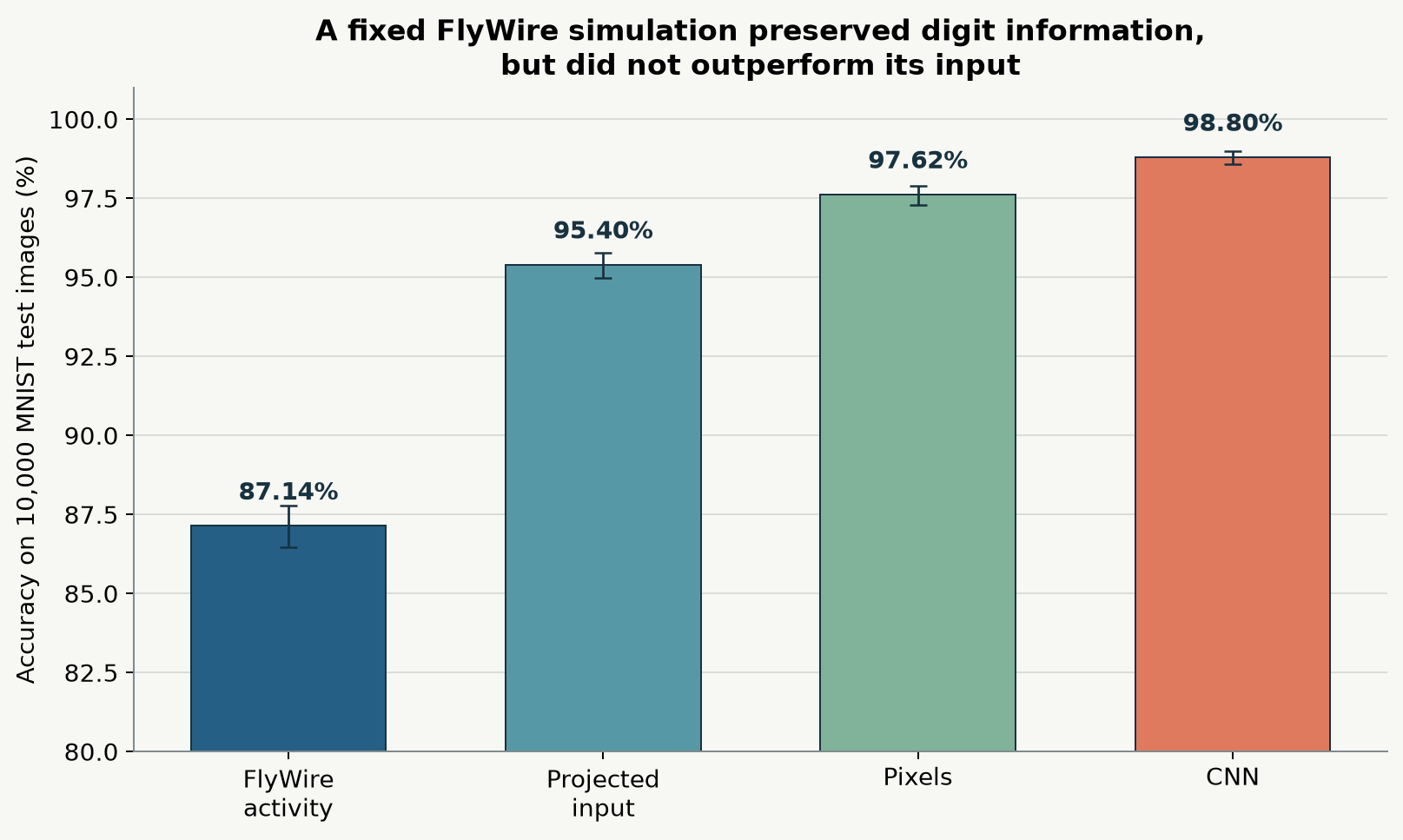
Figure 1. All four results use the same 10,000-image official test set. Error bars show 95% Wilson intervals.
| What the classifier read | Test accuracy |
|---|---|
| Fixed FlyWire activity | 87.14% |
| Artificial projected input, before the recurrent network | 95.40% |
| Original image pixels | 97.62% |
| Conventional CNN | 98.80% |
If we reported only 87.14%, the story would sound like “a fly brain can read digits.” The controls show why that would be wrong.
The classifier that read the artificial input before it entered the recurrent network reached 95.40%. Reading the pixels directly reached 97.62%. A small conventional CNN reached 98.80%.
The neural activity was therefore 8.26 percentage points below its own projected input. The paired 95% bootstrap interval was −8.84 to −7.69 points, so this was not a borderline difference.
The simulation preserved a lot of task information. Under this protocol, it did not improve that information for classification.
Did the signal really pass through the network?
A high decoding score can still be misleading if information leaks around the system. We therefore ran a separate intervention.
We kept the image input, ALPN responses, graph, background activity and timing the same, but disabled transmission from the ALPN population to the rest of the network. On a 5,000-image training and 1,000-image validation subset, the matched linear readout fell from 85.7% to 10.0%.
The input neurons still responded. Downstream Kenyon-cell and mushroom-body-output activity became identical to blank trials.
That result tells us something real and limited: under this protocol, digit-dependent information reached the downstream activity through the intended ALPN output pathway.
It does not tell us that the measured biological topology was better than a random or statistically matched alternative. We have not completed that comparison.
What 87.14% means—and what it does not
The result supports three claims:
- A 139,255-neuron connectome-constrained spiking simulation can be run repeatedly over a full 70,000-image dataset.
- Its fixed downstream activity contains enough structure for substantial out-of-sample digit decoding.
- The decoded signal depends on transmission through the intended input pathway.
It does not support four tempting claims:
- A fruit fly recognizes handwritten digits.
- The FlyWire network learned MNIST internally.
- The biological topology improved classification.
- The simplified neuron dynamics are a biologically validated whole-brain model.
Learning happened in an external readout. The network itself remained fixed. MNIST was chosen because it provides a clean, auditable probe, not because it is biologically natural.
Why the negative comparison matters
I think the upstream control is more important than the headline score.
When a complicated neural system produces a respectable accuracy, it is easy to credit the system. But the input may already contain an easier solution. Measuring the representation before and after the network tells us whether the dynamics added useful structure for the chosen task and readout.
Here they did not. That is not a failed experiment. It narrows the next question.
The next serious test is a topology-controlled one: keep the encoding, weights, degree statistics, readout budget and evaluation set fixed, then compare the measured graph with degree- and weight-matched rewired graphs across multiple seeds. A fresh holdout is also needed because earlier versions of the project had already observed the public MNIST test set.
Internal plasticity would be another project, not a small extension. The moment synapses inside the network learn, the question changes from “what can this fixed substrate preserve?” to “what can this model learn, under which rule, and why?”
The practical lesson
Whole-connectome simulation makes it possible to generate numbers that feel biological because they came from a biological wiring diagram. That makes evidence boundaries more important, not less.
For this experiment, the honest one-sentence result is:
A fixed whole-brain FlyWire-based spiking simulation supported 87.14% MNIST decoding through an external readout, while direct input and pixel controls performed better and no topology advantage was established.
That sentence is less magical than “the fly brain learned digits.” It is also more useful. It tells us what worked, what did not, and exactly which experiment should come next.
References and resources
- Play FlyLab · Digit Arcade.
- Explore Neural Lab and the new Brian2-compatible engine.
- Dorkenwald et al., Neuronal wiring diagram of an adult brain, Nature (2024).
- FlyWire Consortium, FlyWire Whole-brain Connectome Connectivity Data v783.0.
- Stimberg, Brette and Goodman, Brian 2, an intuitive and efficient neural simulator, eLife (2019).
- LeCun et al., Gradient-based learning applied to document recognition, Proceedings of the IEEE (1998).